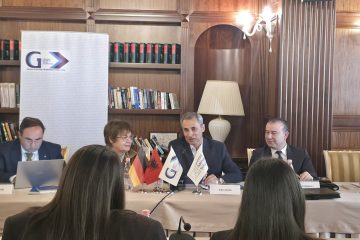
Seminar held on the challenges the Justice system is facing after the completition of the vetting process
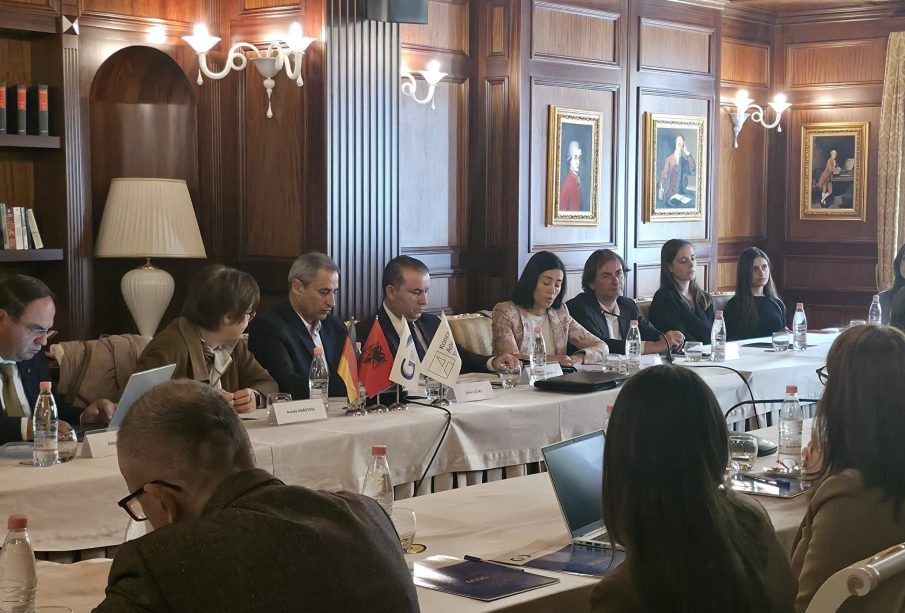
With the question of how the integrity of prosecutors and judges will be ensured in the future
following the dissolution of the Vetting institutions, the ACGG Center and the Konrad Adenauer
Foundation organized an analytical seminar on the post-vetting period, attended by several well-
known experts in the field of jurisprudence, as well as representatives of the media and civil
society. The Executive Director of ACGG, Mr. Arben Çejku, and the representative of KAS, Ms.
Zheni Korçari, emphasized the importance of the justice reform and especially the re-evaluation
process known as “vetting.” The German government and the KAS Foundation have supported
the new Albanian justice system with the aim of making it independent, professional, integrity-
based, and citizen-oriented.
During this roundtable discussion, participants presented an empirical analysis of some of the
main achievements of the vetting process and discussed several of the challenges that
accompanied it. In their remarks, experts pointed out that the conclusion of the re-evaluation
phase this June, with the termination of the Special Appeals Chamber (KPA), opens a largely
unknown chapter regarding the future monitoring and assessment of the professional, ethical, and
financial criteria of prosecutors and judges. It remains unclear how the justice system will ensure
long-term immunity from various negative phenomena.
Renowned constitutional law expert Prof. Dr. Aurela Anastasi, while welcoming the importance
of organizing such a discussion, focused mainly on the legal steps that Parliament should
undertake to regulate the post-vetting period within the Constitution, which may also include the
need for constitutional amendments. She stressed that the constitutional framework governing
the entire vetting process, both during and after its completion, must be properly addressed from
a constitutional perspective, without leaving room for misinterpretation. She also noted the need
to address issues related to the responses of the Strasbourg Court that concern Albania’s
Constitutional Court. Prof. Anastasi raised concerns that during the implementation of the vetting
process, the Constitutional Commentary mechanism was not considered, which could have
facilitated fairer and more accurate decision-making.
Prof. Dr. Altin Shegani, lecturer at the Faculty of Law, shared with the audience some of the best
models of disciplinary oversight within the justice system. He examined various cases,
emphasizing the need for legal mechanisms that ensure accountability and preserve balance
among law enforcement institutions. Among other points, he stated that Albania must carefully
evaluate which models are most suitable for its context and ensure that accountability and the
integrity of judges and prosecutors do not end with the expiration of the vetting mandate.
Dr. Ylli Pjetërnikaj, lecturer at the School of Magistrates, while recognizing the importance of
vetting as an emergency mechanism, stated that the entire system for monitoring and evaluating
the integrity of prosecutors and judges must now enter a phase of normality. He noted that
vetting was generally an exclusionary process, whereas the focus should now shift toward
prevention. Many questions and areas for discussion remain regarding the transition to a normal
institutional procedure, especially as legal and institutional dilemmas have begun to emerge
about how the integrity of the justice system will survive in the absence of vetting bodies and
similar oversight mechanisms. Based on the operational model and achievements of the KPA, he
proposed the establishment of a concrete mechanism such as a National Integrity Council, which
would incorporate within its functions the work currently performed by ILDKPI, relying on the
functional model of the KPA and extending investigative powers beyond disciplinary measures
for prosecutors, judges, and other state officials. Through such a mechanism, the collegial vetting
procedure for review and decision-making would continue, the standards achieved thus far
would be preserved, and the institution’s functional independence would be guaranteed.
Fabian Zhilla, lecturer of law at CIT and former Chief of Cabinet at SPAK, also focused on
SPAK’s role as a continuation of the review of cases handled by the KPA and how this process
would proceed in the future. He emphasized the importance of a serious analysis by all
institutions to ensure that future steps in the functioning of the new justice system take into
account achievements, problems, and ideas for the future, such as Mr. Pjetërnikaj’s proposal for
a National Integrity Commission. According to Mr. Zhilla, preserving the achievements made so
far and continuing efforts toward a justice system that serves citizens remain essential. Beyond
statistics, citizens need an independent and efficient justice system that does not delay decisions
unnecessarily.
Mr. Edmond Hoxhaj, journalist at BIRN, who has continuously followed the vetting process,
presented a very interesting overview of the entire process, highlighting both shortcomings and
achievements. He also agreed on the need for a broader and more professional analysis of the
process, including obtaining the opinions and evaluations of the International Monitoring
Operation (IMO), which made a major contribution throughout this phase. Publishing their
positions, he said, would shed more light on what has taken place. He noted that the media and
civil society organizations have contributed to ensuring as impartial a portrayal of the process as
possible. While supporting the idea of including all officials and politicians in a future vetting
procedure, he expressed reservations about the possibility of preserving the integrity of justice
institutions without a mechanism similar to vetting.
Ms. Erinda Skendaj, head of the Albanian Helsinki Committee, discussed the Committee’s work
in drafting monitoring reports throughout the vetting process, emphasizing the importance of
constructive criticism, which has often been misunderstood. In this context, she recalled that
there had been cases of harsh implementation of the vetting process, but no further investigations
by SPAK in situations where individuals were removed from the system due to unjustified
assets. Overall, vetting demonstrated that Albania is no longer in a phase of impunity, but future
safeguarding mechanisms are necessary to prevent the system from becoming corrupted again.
The Director of ISP, political scientist Dr. Afrim Krasniqi, while recognizing some of the main
achievements of vetting, stated that now, in the phase of a more objective analysis, it becomes
apparent that Albania may not have had sufficient capacity to carry out such a large, urgent, and
challenging reform. He invited attendees and the public to evaluate the results of the reform
beyond mere statistics, focusing instead on the real functioning and citizen-oriented effectiveness
of the new justice institutions. In his view, the new justice system is still not effective and
unfortunately remains far from citizens’ expectations. Furthermore, he expressed surprise that
the vetting bodies, in addition to closing their doors, are also closing their online archives, which
will no longer be accessible for analysis and historical memory. Mr. Krasniqi also noted the
absence of a serious analysis of what has been achieved and of the prospects for a post-vetting
system without oversight mechanisms in the future.
Other experts and participants also intervened during the discussion, converging on the need to
ensure a monitoring process for the integrity of prosecutors, judges, politicians, and other
officials, so that everything achieved thus far does not remain merely a forced event of the past,
but instead becomes a functional model and guarantee for the future of a European-style justice
system.